
by Michael Finn
Key message: Transcriptomic analyses suggest that MSCs cultured in hPL and FBS retain broadly similar gene expression profiles, despite differences in morphology and culture behaviour.
Mesenchymal stromal cells (MSC) are widely used in regenerative medicine due to their ability to expand in culture, differentiate into multiple lineages, and secrete bioactive factors. For decades, fetal bovine serum (FBS) has been used as a standard supplement for MSC expansion. However, because FBS is animal-derived, variable in composition, and less suitable for xeno-free workflows, researchers are increasingly evaluating human platelet lysate (hPL) as an effective alternative.
hPL is a human-derived supplement rich in platelet-associated growth factors and cytokines. Compared to FBS, it has been reported to support faster MSC expansion and may influence cell morphology, adhesion, secretion, and metabolism. However, an important question remains: Does hPL simply change how MSCs behave in culture, or does it fundamentally alter their cellular identity?
This distinction matters. If researchers observe changes such as altered cell shape, focal adhesions, or growth behaviour, it is tempting to assume that the cells have undergone a big biological change. Transcriptomic analysis allows us to test this more carefully by asking whether gene expression patterns are substantially altered in hPL compared to FBS.
In this analysis, we compared publicly available GEO datasets, primarily GSE51869 and GSE87796, to examine whether MSCs cultured in hPL show major transcriptomic differences compared with MSCs cultured in FBS.
Understanding the analysis
Before interpreting the results, it is useful to become familiar with three key concepts:
| Concept | What it measures | Why it matters |
| log2 fold change (logFC) | The direction and magnitude of gene expression change between two conditions | A logFC of 0 indicates no change; +1 indicates a twofold increase; -1 indicates a twofold decrease |
| Adjusted p-value | Statistical significance after correction for thousands of simultaneous tests | Helps reduce false positives when analysing genome-wide expression data |
| Volcano plot | A scatter plot combining effect size and significance | Helps identify genes that are both strongly changed and statistically reliable |
In the analysis, FBS was treated as the reference condition and hPL as the comparison condition. Therefore, positive logFC values indicate genes expressed more in hPL-cultured MSCs, while negative logFC values indicate genes expressed more in FBS-cultured MSCs.
Methodology
The analysis followed a structured bioinformatics workflow:
- Data retrieval
Public GEO datasets relevant to hPL and FBS culture were accessed using keywords, and datasets were included based on predefined inclusion criteria. Datasets GSE51869 and GSE87796 were selected. - Group assignment
Samples were assigned to FBS or hPL groups. Where necessary, non-comparable samples were excluded to avoid confounding effects from different culture formats. - Differential expression analysis
GEO2R was initially performed as an exploratory step. To ensure consistency in data analysis between the datasets, an R/limma-based workflow was developed and used to identify differentially expressed genes. Genes were assessed using logFC and adjusted p-values. - Filtering
Genes were considered statistically significant when they passed an adjusted p-value threshold of <0.05. Where datasets produced few or no significant genes, top-ranked genes were used only for exploratory interpretation. - Pathway analysis
Enrichr was used to explore whether top-ranked or significant genes were associated with known biological pathways. Pathway results were interpreted as biological themes rather than as definitive mechanistic proof.
What we observed
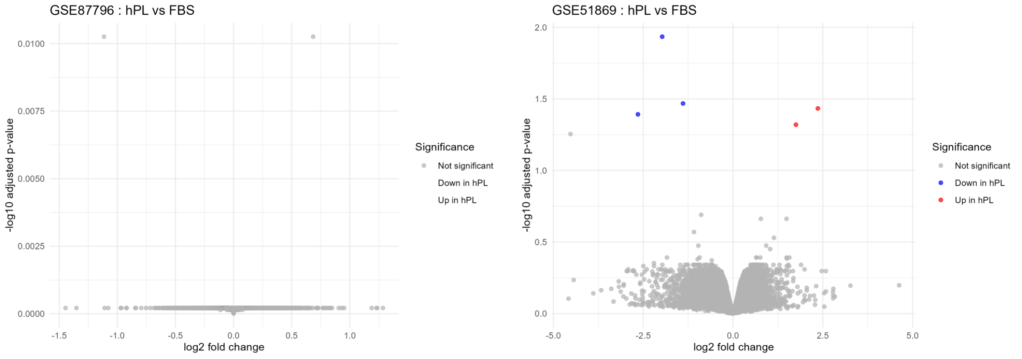
Across both datasets, the most striking observation was the lack of widespread transcriptomic divergence between MSCs cultured in hPL and those cultured in FBS.
In our reanalysis, GSE87796 did not produce genes that met the adjusted p-value threshold of <0.05 under the selected filtering conditions. This does not mean that hPL and FBS have no biological effects. Rather, it suggests that any differences detected in this workflow were modest, variable, or insufficiently powered after correction for multiple testing.
In GSE51869, only a small number of genes remained significant after FDR correction, including:
- EIF1AY
- C15orf48
- GAP43
- HOTAIR
- PDE11A
Because the final filtered comparison in GSE51869 was limited and unbalanced, these genes should be interpreted cautiously. For example, EIF1AY is Y-linked and may reflect donor-related or sex-associated variation between MSC samples rather than a direct effect of hPL supplementation.
Pathway-level interpretation
Although the number of statistically significant genes was small, exploratory pathway analysis using Enrichr suggested possible involvement of pathways related to:
- protein processing
- metabolism
- cell-environment interaction
- membrane trafficking
- glycosylation
- cell communication
These themes are biologically plausible. hPL contains a complex mixture of growth factors, cytokines, extracellular vesicle-associated components, and plasma-derived proteins. MSCs exposed to such an environment may adjust their signalling, secretion, membrane trafficking, and metabolic activity without undergoing a major shift in overall transcriptional identity.
This is an important distinction. A cell may change how it interacts with its environment without becoming a fundamentally different cell type.
What this means biologically
The results suggest that MSCs cultured in hPL and FBS are transcriptionally similar overall and that the cells are essentially tuning themselves to different growth factor concentrations and nutrient profiles of the supplements. This supports the interpretation that visible morphological differences between culture conditions may represent adaptive cell-state changes rather than loss of MSC identity.
This matters because cell culture supplements are often judged by visible outcomes such as morphology, proliferation, or attachment. While these observations are useful, they can be misleading if interpreted in isolation.
Transcriptomic analysis provides an additional layer of evidence. In this case, the lack of widespread gene expression changes suggests that hPL does not strongly disrupt MSC transcriptional identity under the analysed conditions.
Limitations
This analysis has several important limitations:
First, the datasets were generated using different microarray platforms, meaning that probe-level results could not be directly combined. Each dataset had to be analysed separately and interpreted at the gene or pathway level.
Second, sample selection affected statistical power. In GSE51869, some samples were excluded to maintain a cleaner comparison, but this reduced the number of hPL samples available for analysis.
Third, pathway enrichment results from small gene lists should be treated as exploratory. When only a few genes are available, pathway tools can produce unstable or overly specific results. Therefore, enrichment findings should be interpreted as hypothesis-generating rather than definitive.
Takeaways
- hPL and FBS produce broadly similar MSC transcriptomic profiles
The analysed datasets do not support widespread transcriptional reprogramming of MSCs cultured in hPL. - hPL effects may be subtle and functional rather than global
Differences may occur in signalling, secretion, metabolism, membrane trafficking, and cell-environment interaction. - hPL remains a promising xeno-free alternative
The data support further development of hPL as an alternative to FBS, but standardised manufacturing and functional validation remain essential.
Further reading:
Fernandez-Rebollo, E., Mentrup, B., Ebert, R. et al. Human Platelet Lysate versus Fetal Calf Serum: These Supplements Do Not Select for Different Mesenchymal Stromal Cells. Sci Rep 7, 5132 (2017). https://doi.org/10.1038/s41598-017-05207-1
Martins JP, Santos JM, de Almeida JM, Filipe MA, de Almeida MV, Almeida SC, Água-Doce A, Varela A, Gilljam M, Stellan B, Pohl S, Dittmar K, Lindenmaier W, Alici E, Graça L, Cruz PE, Cruz HJ, Bárcia RN. Towards an advanced therapy medicinal product based on mesenchymal stromal cells isolated from the umbilical cord tissue: quality and safety data. Stem Cell Res Ther. 2014 Jan 17;5(1):9. doi: 10.1186/scrt398.

About Michael Finn
Michael is an undergraduate student in Genetics and Cell Biology at Dublin City University. His research interests include combining experimental biology with computational analysis to better understand biological systems.
In his free time, Michael enjoys mixed martial arts and exploring nutrition and exercise science
 ULQA Scientific
Leave a comment