
What are Platelets?
Platelets are anuclear cells that are an important component of the blood, with one microlitre of blood containing 1.5–4.5 x 10⁵ platelets. They are produced in the bone marrow by the fragmentation of the cytoplasm in megakaryocytes. Their primary function is to maintain haemostasis of the vascular system by forming clots that prevent excessive bleeding and initiate cell growth and repair.
How do platelets promote cell growth and repair?
Platelets contain α-granules, which are packed with growth factors, cytokines, and other bioactive molecules that assist cell growth and repair. In the blood, platelets exist in their inactive form and have a plate-like shape. When a blood vessel is damaged, it initiates a chemical signalling cascade that activates nearby platelets. Upon activation, these platelets change their shape to grow tentacles (or pseudopodia), which contact the damaged tissue and other platelets to form clots. The α-granules fuse with the platelet membrane and release their cargo to initiate cell growth and repair at the damaged site.

Inactive platelet
Inactive platelets have a plate-like shape.
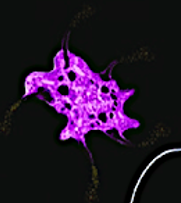
Active platelet
Active platelets change shape to grow pseudopodia that makes contact with damaged tissue and other platelets during clot formation.
What is human platelet lysate?
Human platelet lysate (hPL) is made by artificially activating platelets or disrupting platelet membranes to release the contents within their α-granules. Artificially activating platelets include the addition of thrombin or CaCl21. Meanwhile, physical methods include subjecting platelets to repeated freeze-thaw cycles 2 or sonication3. hPL is routinely used to treat different diseases such as alopecia, osteoarthritis, and cartilage and tendon disorders. Since 2005, hPL has gained prominence as an effective serum alternative in cell culture4.
hPL in cell culture
Annually, billions are spent on developing effective cellular therapies for regenerative medicine and understanding diseases based on cellular models56. However, the results of these studies have little translatability in the clinical setting. A major barrier to the growth of these research areas is the use of foetal bovine serum (FBS) as a universal cell culture supplement. Even though FBS has been used since the 1950s in several standardized protocols, there is growing evidence suggesting that FBS alters the behaviour of cells due to its non-human origin. Moreover, the US Food and Drug Administration and European Medicines Agency both consider the risk of spreading zoonotic diseases as being too high in the use of cellular therapies that use FBS7.
hPL for cell culture is an innovative product that is produced from donated blood that is deemed unsuitable for transfusion. Due to its human origin, hPL offers a superior alternative to FBS and other non-human derived supplements. Compared to FBS-supplemented media, stem cells grown in hPL-containing media have lower doubling times and maintain stemness qualities during in vitro expansion. As it is produced more transparently, its batch-to-batch variability can be reduced to enhance reproducibility in cell culture experiments.
| Human platelet lysate (hPL) | Foetal Bovine Serum (FBS) | |
| Total concentration in cell culture media | 2–10% | 5–20% |
| Main components | Adhesion molecules CytokinesGrowth factors Serum proteinsCoagulation factors | Adhesion molecules CytokinesGrowth factors Serum proteinsCarbohydratesHormones |
| Production method | Uses expired or wasted blood from blood banks that are unsuitable for transfusion. | Ethical issues around the harvesting method from bovine foetus. |
| Clinical relevance of cell culture results | Growing human cells without any non-human proteins increases clinical relevance. | Issues with cells growing in the presence of bovine proteins. |
References
- Bianchetti, A., Chinello, C., Guindani, M., Braga, S. F. M., Neva, A., Verardi, R., . . . Almici, C. (2021). A blood bank standardized production of human platelet lysate for mesenchymal stromal cell expansion: proteomic characterization and biological effects. Frontiers in Cell and Developmental Biology, 9. https://doi.org/10.3389/fcell.2021.650490 ↩︎
- Burnouf, T., Strunk, D., Koh, M. B., & Schallmoser, K. (2016). Human platelet lysate: Replacing fetal bovine serum as a gold standard for human cell propagation? Biomaterials, 76, 371–387. https://doi.org/10.1016/j.biomaterials.2015.10.065 ↩︎
- Doucet, C., Ernou, I., Zhang, Y., Llense, J., Bégot, L., Holy, X., & Lataillade, J. (2005). Platelet lysates promote mesenchymal stem cell expansion: A safety substitute for animal serum in cell-based therapy applications. Journal of Cellular Physiology, 205(2), 228–236. https://doi.org/10.1002/jcp.20391 ↩︎
- Mason, C., Brindley, D., Culme-Seymour, E., & Davie, N. L. (2011). Cell therapy industry: billion dollar global business with unlimited potential. Regenerative Medicine, 6(3), 265–272. https://doi.org/10.2217/rme.11.28
↩︎ - Kim, Y. S., Smoak, M. M., Melchiorri, A. J., & Mikos, A. G. (2019). An Overview of the Tissue Engineering Market in the United States from 2011 to 2018. Tissue Engineering Part A, 25(1–2), 1–8. https://doi.org/10.1089/ten.tea.2018.0138 ↩︎
- Guideline on the use of bovine serum in the manufacture of human biological medicinal products EMA/CHMP/BWP/457920/2012 ↩︎
 ULQA Scientific
Leave a comment