
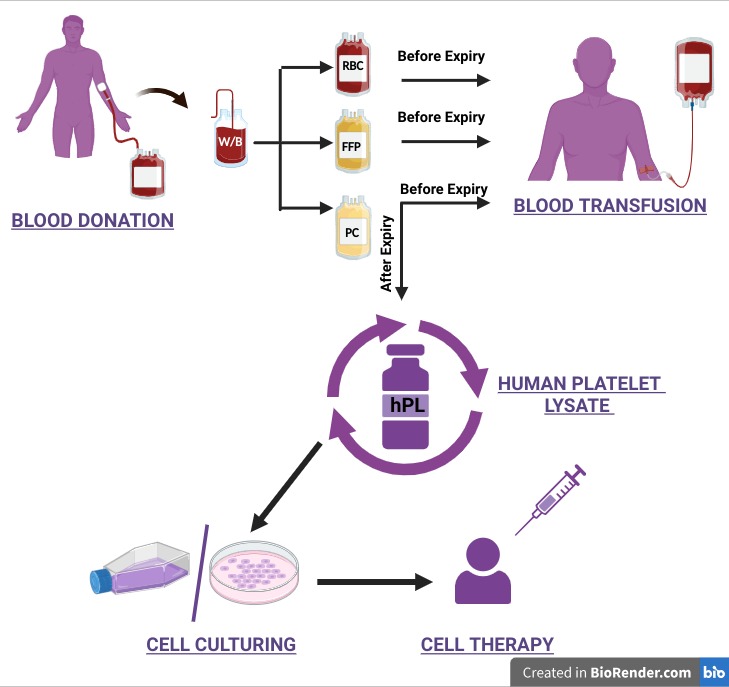
Platelet concentrates (PC) are a critical raw material for the production of human platelet lysate (hPL) for cell culture. In the clinical setting, PC is an important therapeutic agent for various conditions. Due to their short shelf-life (< five days at 22℃), large volumes often go to waste. Recent studies indicate that ~50% of the platelet units that are prepared are discarded. While the majority are discarded due to expiry, a small fraction is also discarded due to red-blood-cell contamination (<1%).1
Such wasted blood products can be developed ancillary materials, such as hPL while reducing biowaste. However, as PC are prepared from donor blood, donor criteria plays an important role in determining hPL performance.
Understanding Platelet concentrates (PC)
Blood comprises various components, including red blood cells, white blood cells, platelets, and plasma. It can be separated into its components and used to treat medical conditions in patients.
PC refers to the platelet component that is prepared from donated blood, and are commonly used to manage bleeding disorders in patients with thrombocytopenia (low platelet count) or poor platelet function. These conditions may arise due to genetic disorders, viral infections, or other medical treatments (chemotherapy). To make up the usual dose, PC from different donors are packaged into ‘units’ based on ABO blood grouping.
Considerations for Donor Blood in hPL Production
PC donor criteria for hPL production adheres to rigorous eligibility standards, similar to those for blood transfusion, ensuring product safety and quality. In addition to blood group, age and sex of the blood donor are also crucial in determining PC quality and resulting hPL.
ABO Blood Group Considerations
While the ABO blood group may not be a critical factor for hPL stromal cells due to their lack of AB antigen expression, it holds significance for endothelial cells which possess the potential to express the AB antigen.2 Till date, Group O PC have been used to make hPL, which minimizes the risk of immune reactions arising from ABO antigen-antibody interactions.3
Donor Sex Consideration
Studies suggest that female donors tend to exhibit higher platelet counts compared to their male counterparts.4 5This variance in platelet counts can impact glucose levels and the concentration of vital proteins within platelets, potentially influencing the performance of hPL in cell culture.6 However, the precise effects of donor sex on hPL efficacy remain a subject of ongoing research.
Donor Age Consideration
Ageing is a process that is associated with many programmed biological changes at the molecular and cellular levels. While platelet quality is relatively stable during middle age (20–60 years), some studies indicate that the proliferative effects on stem cells may be reduced in hPL produced from older platelet donors (>35 years).7
Conclusion
The utilization of platelet concentrates holds immense promise not only in clinical therapeutics but also in the realm of cell culture applications. By optimising donor selection criteria and harnessing wasted blood products, we can unlock the full potential of platelet concentrates, while enhancing the ethical and technical standards in cell culture.
References
- Schallmoser, K., Bartmann, C., Rohde, E., Reinisch, A., Kashofer, K., Stadelmeyer, E., . . . Strunk, D. (2007). Human platelet lysate can replace fetal bovine serum for clinical-scale expansion of functional mesenchymal stromal cells. Transfusion, 47(8), 1436–1446. https://doi.org/10.1111/j.1537-2995.2007.01220.x ↩︎
- Oeller, M., Laner-Plamberger, S., Krisch, L., Rohde, E., Strunk, D., & Schallmoser, K. (2021). Human platelet lysate for good manufacturing Practice-Compliant cell production. International Journal of Molecular Sciences, 22(10), 5178. https://doi.org/10.3390/ijms22105178 ↩︎
- Schallmoser, K., Bartmann, C., Rohde, E., Reinisch, A., Kashofer, K., Stadelmeyer, E., . . . Strunk, D. (2007). Human platelet lysate can replace fetal bovine serum for clinical-scale expansion of functional mesenchymal stromal cells. Transfusion, 47(8), 1436–1446. https://doi.org/10.1111/j.1537-2995.2007.01220.x ↩︎
- Ranucci, M., Aloisio, T., Di Dedda, U., Menicanti, L., De Vincentiis, C., & Baryshnikova, E. (2019). Gender-based differences in platelet function and platelet reactivity to P2Y12 inhibitors. PLOS ONE, 14(11), e0225771. https://doi.org/10.1371/journal.pone.0225771 ↩︎
- Green, M. S., Peled, I., & Najenson, T. (1992). Gender differences in platelet count and its association with cigarette smoking in a large cohort in Israel. Journal of Clinical Epidemiology, 45(1), 77–84. https://doi.org/10.1016/0895-4356(92)90191-o ↩︎
- Dzieciątkowska, M., D’Alessandro, A., Burke, T. M., Kelher, M., Moore, E. E., Banerjee, A., . . . Hansen, K. C. (2015). Proteomics of apheresis platelet supernatants during routine storage: Gender-related differences. Journal of Proteomics, 112, 190–209. https://doi.org/10.1016/j.jprot.2014.08.016 ↩︎
- Lohmann, M., Walenda, G., Hemeda, H., Joussen, S., Drescher, W., Jockenhoevel, S., . . . Wagner, W. (2012). Donor age of human platelet lysate affects proliferation and differentiation of mesenchymal stem cells. PLOS ONE, 7(5), e37839. https://doi.org/10.1371/journal.pone.0037839 ↩︎
 ULQA Scientific
Leave a comment