
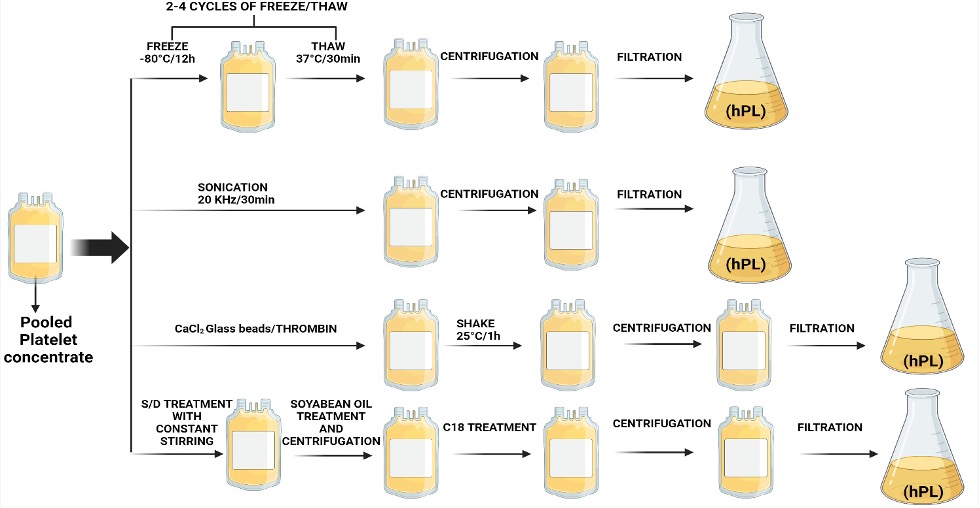
The first step in producing human platelet lysate (hPL) involves the preparation of platelet units from human blood. After conducting a thorough health screen, 350–450 ml of blood is collected from a donor. This blood is referred to as ‘whole blood’, and is either directly used for transfusion or separated into its components. Separated red blood cells, platelets, and plasma are packaged as ‘units’, which are standardised amounts that can be used for specific medical treatments. Platelet units that are considered to be unsuitable for transfusion can be used to produce hPL.
Platelet units are then treated either using physical or chemical activation methods to release their bioactive molecules. The released contents can be suspended in plasma or saline solution to be used as a supplement for cell culture. Physical methods include techniques that mechanically disrupt the integrity of the platelet’s plasma membrane. On the other hand, chemical activation methods use compounds that initiate the signalling pathways that lead to the natural activation of platelets.
Physical Methods for hPL production
- Repeated freeze-thaw method: This method is most used due to its cost-effectiveness and low need for specialised equipment. It involves the lysis of platelets using two to four repeated freeze (-196 to -20 ℃) and thaw (+22 to 37 ℃) cycles. However, this method can be time-consuming and labour-intensive.1 2
- Sonication: Uses high-frequency sound to disrupt the cell membrane. It is a rapid method that can be done either independently or in combination with freeze/thaw cycles. For hPL production, platelets are sonicated at 20 kHz for 30 minutes3. Due to the nature of sonication, the resulting product can vary and increase the risk of destroying crucial bioactive molecules.
- Solvent/Detergent (S/D) treatment method: Uses solvents (e.g., Tri(n-butyl) phosphate) and an aqueous detergent solution (e.g., Triton X-45 or Tween 80) to disrupt cell membrane lipids. Oil extraction is performed to recover the added S/D before producing hPL.The method can help prevent microbial contamination, including enveloped viruses but it can be labour-intensive.4
- Pulse electric field (PEF): This method induces permeabilisation of the cell membrane using ns–µs-range pulses and a high electric field of 12.5 kV/cm.5 Even though the method can result in reducing the time and enhance the stability of growth factors, it is associated with a high operational cost.
Chemical Methods for hPL production
In the body, chemical signals from damaged tissue initiate platelet activation. One of these signals includes elevated levels of calcium ions. In the blood, the calcium ions released from damage cells activates thrombin from its inactive form, prothrombin. Thrombin in turn converts soluble fibrinogen to its insoluble fibrin form. The fibrin entraps circulating platelets to form a clot. Clotting results in the activation of platelets, as they change shape to release their cell repair and growth promoting cargo, also known as platelet degranulation.
A similar mechanism for platelet degranulation can be replicated outside the body to produce hPL. This involves the addition of calcium salts, thrombin, a mixture of thrombin and calcium salts, or collagen type-I. Till date, the addition of CaCl2 and thrombin + CaCl2 are most commonly used to produce hPL for cell culture. However, the addition of these platelet activators can complicate the use of hPL in cell therapy.
Conclusion
Overall, the production of hPL is a meticulous process aimed at harnessing the potential of platelet-derived bioactive molecules for cell culture. Physical or chemical activation methods can be employed based on factors like efficiency, cost-effectiveness, and the specific requirements of hPL production. Regardless of the production method, hPL production is a transparent process that can ensure a more consistent product compared to traditional cell culture supplements, namely foetal bovine serum (FBS).
References
- Bianchetti, A., Chinello, C., Guindani, M., Braga, S., Neva, A., Verardi, R., . . . Almici, C. (2021, April 6). A Blood Bank Standardized Production of Human Platelet Lysate for Mesenchymal Stromal Cell Expansion: Proteomic Characterization and Biological Effects. https://doi.org/10.3389/fcell.2021.650490 ↩︎
- Baik, S. Y., Lim, Y. A., Kang, S. J., Ahn, S. H., Lee, W. G., & Kim, C. H. (2013, December 6). Effects of Platelet Lysate Preparations on the Proliferation of HaCaT Cells. https://doi.org/10.3343/alm.2014.34.1.43 ↩︎
- Bernardi, M., Albiero, E., Alghisi, A., Chieregato, K., Lievore, C., Madeo, D., . . . Astori, G. (2013). Production of human platelet lysate by use of ultrasound for ex vivo expansion of human bone marrow–derived mesenchymal stromal cells. Cytotherapy, 15(8), 920–929. https://doi.org/10.1016/j.jcyt.2013.01.219 ↩︎
- Burnouf, T., Tseng, Y.H., Kuo, Y.P., & Su, C.Y. (2008, March 25). Solvent/detergent treatment of platelet concentrates enhances the release of growth factors. Transfusion, 48(6), 1090–1098. http://doi.org/10.1111/j.1537-2995.2008.01691.x. ↩︎
- Salvador, D., Almeida, H., Rego, D., Mendonça, P., Sousa, A. P., Serra, M., & Redondo, L. (2022, June 7). Pulsed Electric Fields for Valorization of Platelets with No Therapeutic Value towards a High Biomedical Potential Product—A Proof of Concept. https://doi.org/10.3390/app12125773 ↩︎
 ULQA Scientific
Leave a comment